

The intent of the HTC Distinguished Teacher-Scholar Lecturer Award is to recognize annually a Coastal Carolina University faculty member who has distinguished him/herself as a teacher, a scholar and a communicator. The Awardee is an individual who embodies the University’s teacher-scholar ideal of searching for and transmitting knowledge through critical inquiry and teaching in his or her own discipline and supports and appreciates critical inquiry and teaching in the other disciplines of the University. Nominees for this prestigious award come from any area of knowledge or expression at the University. The committee that recommends selection of the awardee is unique in that it comprises faculty members and representatives from the student body, staff, and administration.
The HTC Distinguished Teacher-Scholar Lecture Series, which was established in 1996 by the University, in cooperation with the Horry Telephone Cooperative, recognizes the special role of communication in the teacher-scholar process. To underscore the communication aspect of the teacher-scholar process, the Awardee presents an original lecture/presentation to the University community and community guests on a topic of his/her choice that illustrates the depth and breadth of the Awardee's teacher-scholar abilities.








-
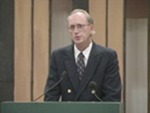
So Fine a Beach: Peter Horry's Summer of 1812
Roy Talbert Jr.
Horry is South Carolina's largest county and the home of the internationally known Grand Strand and Myrtle Beach, but the reading public knows very little about the person after whom it is named. There is no biography of Peter Horry, not even an essay of any length. For nearly two hundred years, when professional historians noticed him at all, they paused for a few humorous and embarrassing anecdotes and ignored the several ways he earned considerable historical significance. Invariably, they got his dates wrong. Even the modest stone at his grave is incorrectly marked.
In 1812, Peter Horry reckoned that he was born on March 12, 1743 or 1744, in what is now Georgetown County. He came from Huguenot stock a descendent of Elias, the original Horry who fled France for the religious freedom of colonial South Carolina. Peter always regretted that his family did not return him to the old country for an education, and what learning he got came at a free school established by the Winyaw Indigo Society. He also retained bad memories of his days as a youth apprenticed to a Georgetown merchant. Conditions were horrible, and he might have run away, had not his aunt, Magdeline Horry Trapier, helped him.
"Even now," he wrote of the experience, "tho 50 years have Passed, I feel what I cannot describe." Peter's family developed rice plantations on the North, or "French," Santee and on Winyaw Bay. Eventually he possessed four plantations, the best known of which is Belle Isle, now a marina and community south of Georgetown. Dover and Prospect Hill adjoined Belle Isle, and Cove plantation was on the Santee.
-
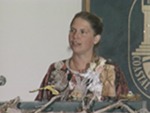
The Story Way of Knowing in the Context of Community
Sara L. Sanders
Twenty-one years ago when I began teaching, I didn't think about ways of knowing at all. I taught as I had been taught and considered teaching content the point. Now I think of myself as teaching people instead of subjects and look for the answers to these questions: What is knowing? What is education? What is learning?
The first "truth" I learned about teaching was that a sense of community among the learners makes a dramatic difference in what is learned. I began to understand this when I taught in the intensive English Program for Internationals at the University of South Carolina. Students there were far from home, learning a new language and a new culture. They were most comfortable and most successful when they felt supported in this massive undertaking by their teachers and fellow learners.
We thrive and learn when our stories and the stories of others are heard and honored. Through the specific story, the universal truth is revealed.
-
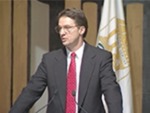
Insuring Domestic Tranquility and Securing the Blessings of Liberty in 21st Century America
Edgar L. Dyer III
At what point does freedom become anarchy? At what point does order become totalitarian?
The tension between freedom and order challenges every society. The successful balancing of freedom and order is fundamental to a civilized social structure. Governments limit individual rights by legislating collective order. In a society that values maximum individual freedom, legal and political inquiry should focus on how to best minimize such limitations while keeping the peace.
The importance of this balance of freedom and order is the subject of my remarks and my overriding question is how to best secure a proper balance for ourselves and, more importantly, for our posterity. We are hard-pressed to find a more noble statement preceding a political document than the Preamble to the Constitution of the United States of America. Along with a more perfect union, the Founders sought to establish justice, to provide for a common defense, and to promote the general welfare.
They also wanted to insure what they termed "domestic tranquility" - or order - and to secure the "blessings of liberty" - or freedom - for themselves and for their posterity.
Thus, the title of my lecture invokes several goals of the Founders. The eloquence of "Insuring Domestic Tranquility and Securing the Blessings of Liberty in 21st Century America" is borrowed wholesale from those who drafted the Constitution at the Philadelphia Convention of 1787, one of the grandest gathering of minds in the history of humanity.
How do we pass forward this gift of civilization that was given to us by the Founders and by the grace of God? My remarks are aimed toward the next century, which is closely upon us.
Will 21st Century America still be a land of opportunity? Will our society be able to maintain the order and domestic tranquility necessary for progress? Will freedom and the blessings of liberty still guide America to be the "city on a hill" and beacon to all nations that we have been since 1776?
These are the questions that sowed the seeds for this lecture.